
The History of Vatican City: A Journey Through Time
Vatican City, the smallest independent state in the world, holds a history as vast and profound as its spiritual significance. From ancient Roman necropolises to its current role as the global center of the Catholic Church, its story is an intricate tapestry woven through millennia of faith, power, and unparalleled artistic achievement. Join us on a captivating journey through the epochs that shaped this extraordinary sovereign state.
Ancient Roots: Before Christianity
Long before it became the heart of Catholicism, the area now known as Vatican City was a modest hill on the western bank of the Tiber River, outside the ancient city of Rome. This "Vatican Hill" (collis Vaticanus) was largely uninhabited due to its marshy terrain and lack of water access, making it unsuitable for large settlements. Instead, it became a burial ground, a necropolis for both the wealthy and the common people of Rome.
The most infamous Roman structure on the Vatican Hill was the Circus of Nero, a vast chariot racing arena built by Emperor Caligula and completed by Nero. It was here, around 64 AD, that many early Christians, including Saint Peter, were martyred during Nero's persecutions. Tradition holds that Saint Peter was crucified upside down and buried in the adjacent necropolis. This burial site would become the genesis of one of the world's most significant religious centers.
The Rise of Christianity and Papal Authority
The turning point for the Vatican Hill arrived with Emperor Constantine the Great. After his conversion to Christianity and the Edict of Milan in 313 AD, which granted religious tolerance throughout the Roman Empire, Constantine commissioned the construction of a grand basilica directly over what was believed to be Saint Peter's tomb. This original, Old St. Peter's Basilica stood for over a thousand years, becoming a major pilgrimage site and solidifying the area's spiritual importance.
Over the following centuries, the Bishops of Rome, known as Popes, gradually accumulated temporal power alongside their spiritual authority. Donations of land and political influence saw the formation of the Papal States, a vast territory in central Italy directly governed by the Pope. The Vatican, though not yet a distinct state, grew in importance as the administrative and spiritual headquarters of the Church. The medieval era saw the popes move their residence between various Roman palaces, eventually settling in the Vatican Palace.
Did You Know?For nearly 70 years in the 14th century, the papacy was based in Avignon, France. Its return to Rome in 1377 marked a crucial step in re-establishing the city's central role in the Catholic world.
Renaissance and Baroque Grandeur
The Renaissance ushered in an era of unparalleled artistic and architectural ambition, transforming the Vatican into a masterpiece of human ingenuity. In the early 16th century, Pope Julius II initiated the demolition of Old St. Peter's Basilica to make way for a new, grander structure that would reflect the Church's renewed power and prestige. The construction of the current St. Peter's Basilica spanned over a century, involving luminaries like Bramante, Michelangelo, Raphael, and Bernini.
During this period, the Vatican became a patron of the arts like no other. Michelangelo famously painted the ceiling of the Sistine Chapel between 1508 and 1512, followed by "The Last Judgment" on its altar wall. The Popes also began to amass vast collections of art and antiquities, which would eventually form the basis of the Vatican Museums, one of the world's largest and most important art collections.
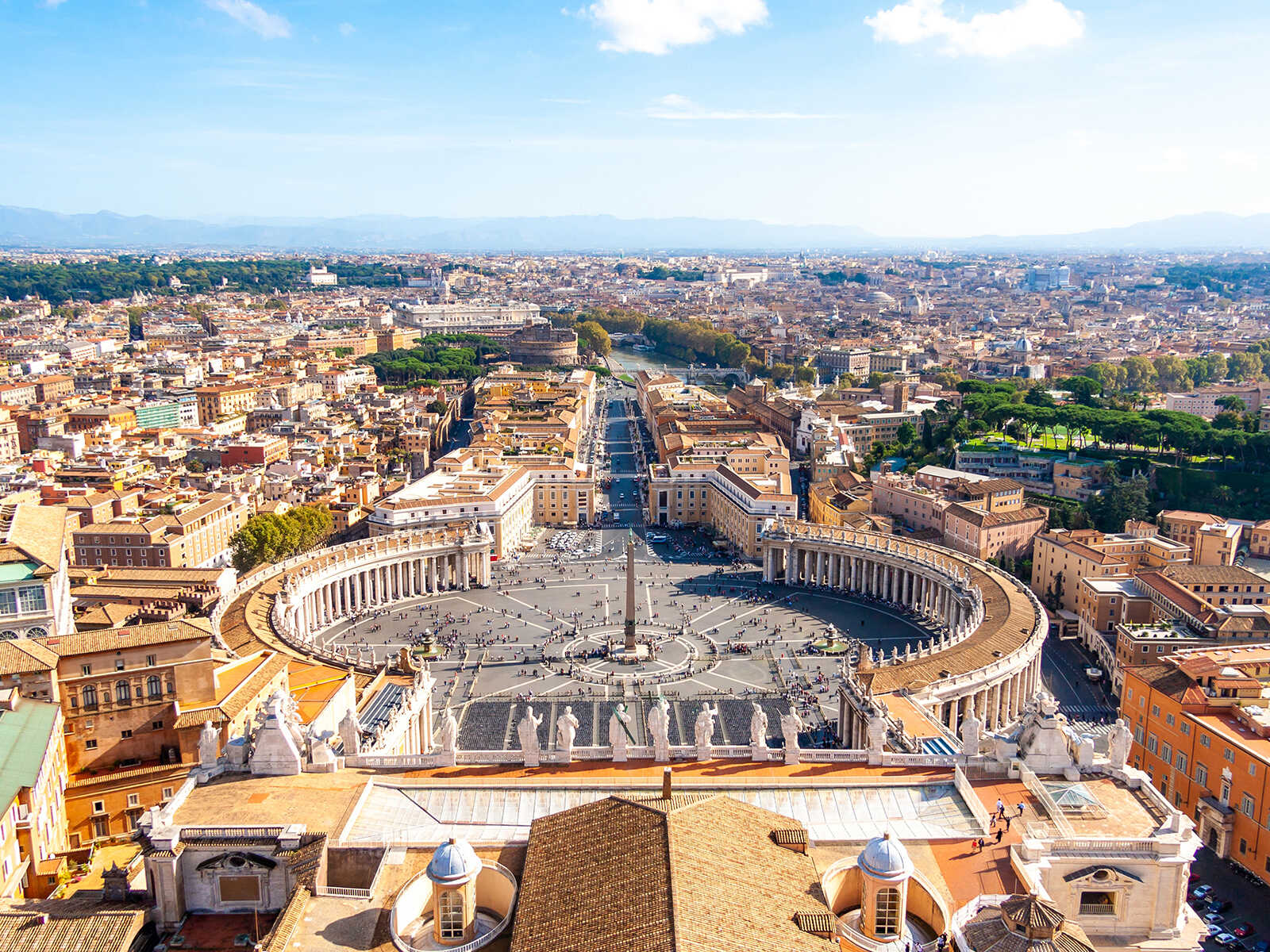
In the 17th century, Gian Lorenzo Bernini designed the magnificent colonnade enclosing Piazza San Pietro, creating a symbolic embrace for pilgrims arriving at the Basilica. These artistic and architectural endeavors cemented the Vatican's status as a cultural as well as a spiritual beacon, drawing artists, scholars, and pilgrims from across Europe and beyond.
The Papal States and Their Decline
For centuries, the Popes ruled the Papal States as temporal monarchs, wielding significant political and military power across central Italy. This dual role as spiritual leader and temporal ruler often led to complex political entanglements, conflicts, and shifting alliances with European powers.
However, the 19th century brought radical changes to the Italian peninsula. The rise of Italian nationalism and the movement for national unification (theRisorgimento) challenged papal temporal authority. Piece by piece, the Papal States were absorbed into the nascent Kingdom of Italy. The final blow came in 1870 when Italian troops entered Rome, making it the capital of a unified Italy. This event marked the end of the Papal States and began what was known as the "Roman Question," a period of nearly 60 years during which the Popes considered themselves "prisoners in the Vatican," refusing to recognize the legitimacy of the Italian state.
The Birth of Modern Vatican City
The "Roman Question" was finally resolved in 1929 with the signing of the Lateran Treaty between the Kingdom of Italy, represented by Benito Mussolini, and the Holy See, represented by Cardinal Pietro Gasparri. This historic agreement recognized Vatican City as an independent sovereign state, guaranteeing its neutrality and inviolability. In return, the Holy See recognized the Kingdom of Italy with Rome as its capital.
The treaty established Vatican City as a unique monarchical-sacerdotal state, with the Pope as its absolute sovereign. It provided for its own postal service, coinage, railway station, and radio station, ensuring its complete independence from Italy. This pivotal moment transformed the small enclave into the smallest independent state in the world, dedicated to serving the spiritual needs of over a billion Catholics globally.
Vatican City Today: A Spiritual and Cultural Hub
Today, Vatican City continues to thrive as the spiritual and administrative heart of the Roman Catholic Church. It is home to the Pope, the Roman Curia (the administrative body of the Holy See), and countless religious and cultural institutions. Despite its diminutive size, it holds immense global influence, serving as a beacon of faith, diplomacy, and cultural heritage.
Visitors from around the world flock to experience its profound history and breathtaking beauty. Key attractions include the awe-inspiring St. Peter's Basilica, where you can marvel at Michelangelo'sPietàand ascend to the dome for panoramic views; the magnificent Vatican Museums, home to masterpieces like the Laocoön Group and the Raphael Rooms; and, of course, the unparalleled Sistine Chapel with its iconic frescoes. Beyond these famous sites, the tranquil Gardens of Vatican City offer a serene escape, and the colorful Swiss Guard stand as guardians with centuries of tradition.
Planning Your Visit
Exploring Vatican City is a profound experience, blending spiritual reverence with artistic appreciation. To make the most of your journey through its rich history:
- Dress Respectfully:Remember that Vatican City is a sacred place. Modest attire is required for entry to the Basilica, Sistine Chapel, and Vatican Museums. Shoulders and knees must be covered.
- Book Ahead:Especially for the Vatican Museums and Sistine Chapel, purchasing tickets online in advance is highly recommended to avoid long queues.
- Allow Time:There is an immense amount to see. Plan at least half a day, if not a full day, to truly absorb the historical and artistic treasures.
From its humble origins as a Roman burial ground to its current status as a global spiritual powerhouse, the history of Vatican City is a testament to enduring faith, human artistry, and political evolution. It stands not merely as a state, but as a living museum, continually telling the story of Western civilization and the Catholic Church.