
History of Lebanon: From Ancient Civilizations to Modern Day
Nestled on the eastern shores of the Mediterranean, Lebanon is a land steeped in history, a vibrant tapestry woven from countless civilizations. From the ingenious Phoenicians to the grandeur of the Roman Empire and the enduring spirit of its modern-day people, its story is one of innovation, resilience, and cultural exchange. Journey with us through the millennia to uncover the layers of history that have shaped this remarkable nation.
Ancient Roots: The Phoenicians and Beyond
Lebanon's story truly begins with thePhoenicians, an ancient Semitic civilization that flourished from around 3000 BCE. Renowned as master mariners and traders, they established a vast commercial network across the Mediterranean, pioneering navigation techniques and founding colonies as far as Spain and North Africa. Their most profound legacy, however, is the development of the first phonetic alphabet, a revolutionary system that laid the foundation for most modern alphabets.
The coastal cities of Byblos, Tyre, and Sidon were powerful city-states, each contributing significantly to Phoenician dominance.Byblos, one of the oldest continuously inhabited cities in the world, served as a crucial port for cedar wood exports to ancient Egypt. Further south,Tyre became a formidable naval power, famed for its purple dye derived from murex snails.
Following the decline of Phoenician independence, the region fell under the sway of successive mighty empires. The Egyptians, Assyrians, Babylonians, and Persians each left their mark, influencing local culture, administration, and trade routes. Despite foreign rule, the Phoenician cities often retained a degree of autonomy, their maritime prowess making them valuable assets to their conquerors.
Classical Eras: Greeks and Romans
The arrival ofAlexander the Greatin 332 BCE marked a new Hellenistic chapter. After a fierce seven-month siege, Tyre fell to Alexander, signaling the end of independent Phoenician city-states. Greek culture and language permeated the region, blending with local traditions.
In the 1st century BCE, Lebanon became part of the sprawlingRoman Empire. Under Roman rule, the region, particularly the fertile Beqaa Valley, experienced a period of remarkable prosperity. Grand temples, theaters, and public buildings were constructed, showcasing Roman engineering and artistic prowess. The city of Heliopolis, now known as Baalbek, became home to some of the most magnificent Roman temple complexes ever built, dedicated to Jupiter, Bacchus, and Venus.Tyre also flourished, boasting impressive Roman hippodromes and bathhouses.
Byzantine and Early Islamic Period
As the Roman Empire split, Lebanon became part of the Eastern Roman orByzantine Empire. Christianity, which had begun to spread during the late Roman period, solidified its presence. Monastic communities thrived in the rugged valleys, particularly in the Kadisha Valley, a UNESCO World Heritage site known for its early Christian monasteries carved into cliffs.
Fun Fact:The word "Lebanon" itself is derived from the Semitic root "LBN," meaning "white," referring to the snow-capped peaks of its majestic mountains.
The 7th century CE saw the swift expansion of theIslamic Empire, bringing the Levant under Muslim rule. The region witnessed a gradual Arabization and Islamization, though Christian communities, particularly the Maronites, maintained their distinct religious and cultural identity, often seeking refuge in the mountainous terrain. Successive Islamic dynasties, including the Umayyads, Abbasids, and Fatimids, governed the area, contributing to its rich cultural mosaic.
The Crusades and Mamluk Rule
From the late 11th to the late 13th centuries, the coastal areas of Lebanon became strategic points in theCrusades. European Crusaders established several fortresses and lordships, often clashing with local Muslim rulers. The region served as a crucial bridge between East and West, witnessing intense periods of conflict and cultural exchange.
By the late 13th century, theMamluk Sultanate, based in Egypt, consolidated its control over the Levant, expelling the last of the Crusaders. Under Mamluk rule, administrative structures were strengthened, and trade routes were re-established, though the Maronite community continued to preserve its unique identity in the safety of the mountains.
Ottoman Empire: Four Centuries of Influence
In 1516, theOttoman Empireconquered the Mamluks, initiating a period of nearly 400 years of Ottoman rule in Lebanon. While officially part of the Ottoman Empire, certain regions, particularly Mount Lebanon, enjoyed significant autonomy under local feudal lords. The Ma'an dynasty, and later the Chehab dynasty, rose to prominence, fostering a unique blend of Christian and Druze communities.
One of the most notable figures wasFakhreddine II(1572-1635), a Druze emir who expanded his control, modernized administration, and promoted trade and culture, attracting Italian merchants and artisans. His legacy paved the way for future semi-autonomous rule. The grandeur of this era is perhaps best exemplified by Beiteddine Palace, a stunning example of 19th-century Lebanese architecture, built by Emir Bashir Chehab II.
During the latter part of Ottoman rule, the region experienced increasing European influence, particularly from France, which cultivated close ties with the Maronite Christian community. This influence played a significant role in the political developments leading up to the 20th century.
French Mandate and Independence
Following the collapse of the Ottoman Empire after World War I, the Sykes-Picot Agreement (1916) and the subsequent San Remo Resolution (1920) placed Lebanon under aFrench Mandate. In 1920, France proclaimed the State of Greater Lebanon, expanding the boundaries of the traditional Mount Lebanon to include the coastal cities and the Beqaa Valley, aiming to create a Christian-majority state.
The French Mandate introduced modern administrative structures, education systems, and infrastructure, but also faced resistance from various factions. After years of political negotiations and growing nationalist sentiment, Lebanon achieved fullindependencein 1943. This was formalized by the "National Pact," an unwritten agreement that established a confessional power-sharing system, allocating political positions based on religious communities to ensure representation for all.
Post-Independence: Growth and Conflict
The decades immediately following independence were often referred to as Lebanon's "Golden Age." Beirut blossomed into the "Paris of the Middle East," a hub of finance, tourism, and culture. The country thrived economically, attracting visitors and businesses from across the globe, thanks to its liberal economy and unique cultural blend.
However, underlying sectarian tensions and regional conflicts eventually erupted into the devastatingLebanese Civil War(1975-1990). This complex conflict involved numerous internal and external actors, leaving a profound scar on the nation. The war ended with the Taif Agreement in 1989, which restructured the political system and paved the way for national reconciliation.
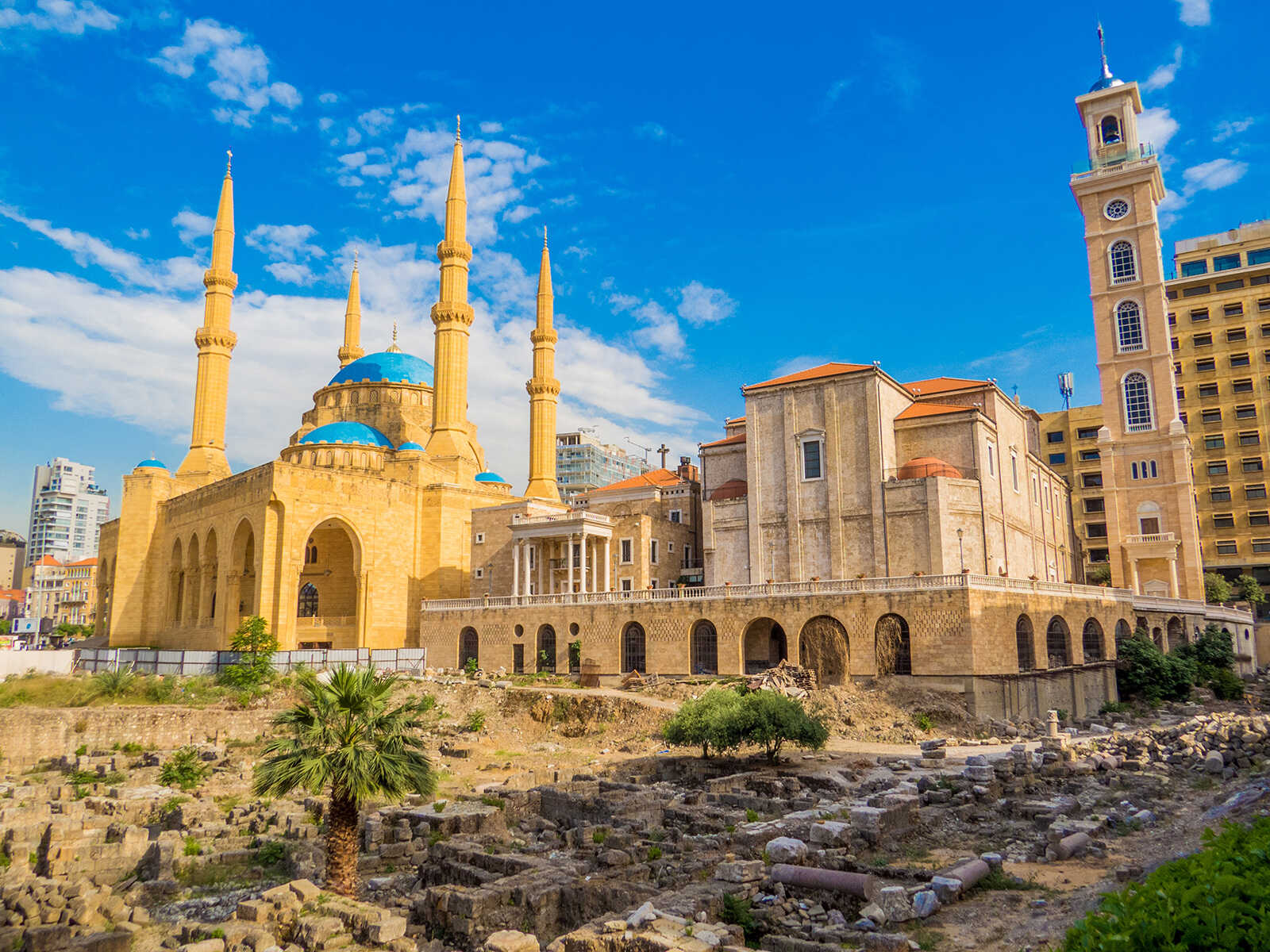
The post-war era focused on national reconstruction and rebuilding infrastructure. Downtown Beirut, heavily damaged during the war, underwent extensive renovation, symbolizing Lebanon's resilience. The magnificent Mohammad Al-Amin Mosque, with its distinctive blue domes, stands as a prominent landmark in the rebuilt city center.
Modern Day Lebanon: Challenges and Enduring Spirit
In recent decades, Lebanon has continued to navigate complex political, economic, and social challenges. Despite these difficulties, the Lebanese people continue to demonstrate remarkable resilience, creativity, and an unwavering commitment to their vibrant culture.
The country remains a land of stark contrasts and profound beauty, where ancient ruins stand testament to bygone eras, and the spirit of innovation continues to thrive. From the majestic Cedars of God, an ancient symbol of the nation, to the bustling streets of Beirut, Lebanon's history is not just a tale of the past but a living, breathing narrative that continues to unfold.
Exploring Lebanon means stepping into a living museum, where every stone, every city, and every face tells a story of a civilization that has stood the test of time. It's an experience that offers deep insights into the human spirit's capacity for endurance, adaptation, and unwavering hope.