
A Brief History of Kazakhstan: From Nomads to Modern Nation
Kazakhstan, the ninth-largest country in the world, boasts a history as vast and varied as its landscapes. From its ancient nomadic roots to its present-day status as a dynamic independent nation, understanding Kazakhstan's past is key to appreciating its unique culture and enduring spirit.
Ancient Roots and Nomadic Empires
The story of human habitation on the Kazakh Steppe stretches back millennia. Archaeological evidence points to early human presence, with hunter-gatherer societies eventually giving way to pastoral nomads who mastered horse riding and ironwork. These early inhabitants were part of a complex web of tribal confederations that shaped Central Asia.
Around the 7th century BCE, the Scythians (Saka in local parlance) emerged as dominant forces, known for their fierce warrior culture and elaborate burial mounds (kurgans) filled with gold artifacts. Following them, various Turkic tribes established powerful khaganates, influencing vast swathes of Eurasia. These early states were characterized by a nomadic lifestyle, relying on livestock and seasonal migrations across the immense steppe.
Did you know?The domestication of the horse is believed to have first occurred on the Kazakh Steppe, profoundly impacting not only local cultures but also global trade and warfare.
Over centuries, different empires and peoples left their mark. The legendary Silk Road, a network of trade routes connecting East and West, passed through these lands, bringing with it goods, ideas, and diverse populations. Sites like Tamgaly-Tas offer glimpses into this ancient past with their captivating petroglyphs.
The Golden Horde and the Rise of the Kazakh Khanate
The 13th century brought a monumental shift with the Mongol invasion led by Genghis Khan. Kazakhstan became an integral part of the vast Mongol Empire, later falling under the dominion of the Golden Horde. While destructive in its initial phase, Mongol rule also fostered new political structures and connections across the empire.
As the Golden Horde weakened, new power centers emerged. By the mid-15th century, several Turkic tribes coalesced to form theKazakh Khanate, marking the true genesis of the Kazakh people as a distinct ethno-political entity. The khanate was founded by Janibek Khan and Kerei Khan, who led their followers away from the Uzbek Khanate, seeking independence. This period saw the development of a unique nomadic Kazakh identity, with a rich oral tradition, distinct legal codes (Zheti Zhargy), and a strong sense of tribal kinship.
The Khanate thrived for several centuries, expanding its territory and resisting incursions from neighboring powers. Its society was structured around three main Hordes or Zhuzes – the Senior (Uly), Middle (Orta), and Junior (Kishi) – each with its own territories and tribal affiliations, yet united under a common Kazakh identity.
Spiritually, Islam, which had slowly spread through Central Asia via the Silk Road and Sufi missionaries, became firmly entrenched during this period. The Mausoleum of Khoja Ahmed Yasawi in Turkistan stands as a testament to the profound influence of Sufism and Islamic architecture during the late medieval period, drawing pilgrims from across the region.
Russian Expansion and Colonial Rule
By the 18th century, the Kazakh Khanate faced increasing pressure from various directions, including the Dzungars from the east and the expanding Russian Empire from the north. Weakened by internal strife and external threats, the Kazakhs gradually sought protection from Russia. This "protection" soon morphed into annexation, as the Russian Empire systematically integrated Kazakh lands into its vast territory throughout the 18th and 19th centuries.
Russian colonization brought significant changes: settlement of Russian and Ukrainian peasants, land confiscation, and the imposition of a foreign administrative system. This period saw a gradual erosion of traditional nomadic life and the rise of tensions between the indigenous Kazakh population and the new settlers. Despite several uprisings, Kazakh resistance was ultimately suppressed, and the region became a vital part of the Russian Empire, valued for its strategic location and natural resources.
The Soviet Era: Transformation and Trauma
The Russian Revolution of 1917 and the subsequent formation of the Soviet Union ushered in one of the most transformative and traumatic periods in Kazakh history. In 1920, the Kazakh Autonomous Soviet Socialist Republic (ASSR) was established, becoming a full Union Republic (Kazakh SSR) in 1936.
Soviet policies aimed at rapidly modernizing and collectivizing society had devastating consequences. The forced collectivization of agriculture in the late 1920s and early 1930s, coupled with the elimination of the nomadic way of life, led to a catastrophic famine (often referred to as the Kazakh Holodomor). Millions of Kazakhs perished, and many more were forced to flee, permanently altering the demographic makeup of the republic.
Despite the immense suffering, the Soviet era also brought industrialization, urbanization, and advancements in education and healthcare. Kazakhstan became a crucial industrial and agricultural hub within the Soviet Union. The Virgin Lands Campaign of the 1950s saw massive tracts of the steppe plowed for grain production, further altering the landscape and bringing millions of new settlers.
Kazakhstan also played a unique role in Soviet space exploration, hosting the Baikonur Cosmodrome, from which Sputnik 1 and Yuri Gagarin's historic flight were launched. However, it also bore the heavy burden of Soviet nuclear ambitions, with the Semipalatinsk Test Site being the primary location for nuclear weapons testing, causing long-lasting environmental and health impacts. Furthermore, the Soviet-era agricultural projects, particularly those related to cotton farming, led to the tragic ecological disaster of the Aral Sea.
Independence and Nation Building
As the Soviet Union began to unravel in the late 1980s, Kazakhstan, under the leadership of Nursultan Nazarbayev, declared its sovereignty in October 1990 and then its full independence on December 16, 1991, becoming the last Soviet republic to do so. This marked the beginning of a new chapter – one of nation-building, economic reform, and establishing its place on the global stage.
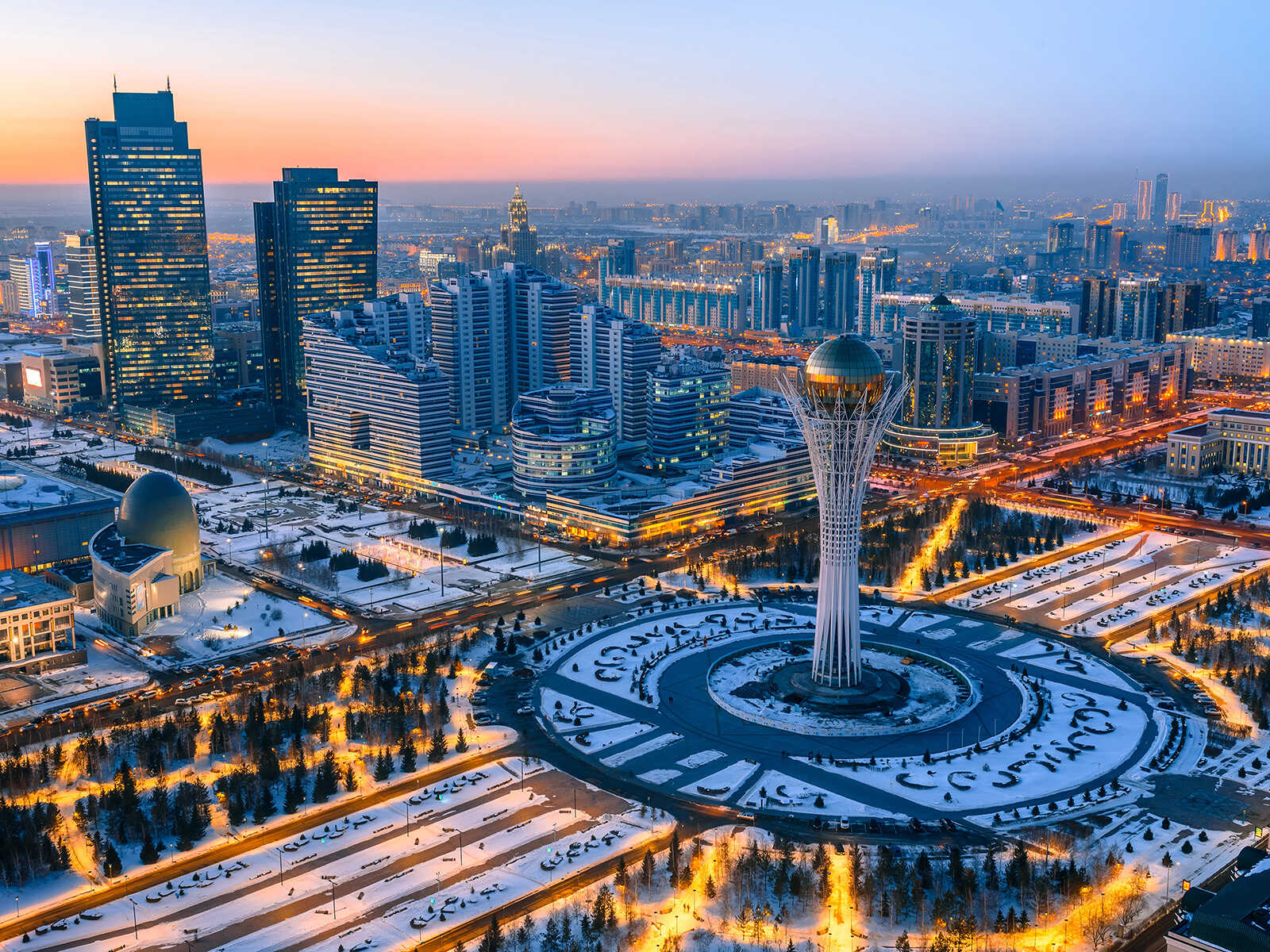
The post-independence period saw Kazakhstan embark on a rapid transition to a market economy, leveraging its vast natural resources, particularly oil and gas. The country moved its capital from Almaty to a newly developed city in the central steppe, which was named Astana (now officially back to Astana, after a period as Nur-Sultan). This new capital became a symbol of modern Kazakhstan's ambition and dynamism, boasting impressive contemporary architecture like the iconic Baiterek Tower, the futuristic Khan Shatyr Entertainment Center, and the grand Hazret Sultan Mosque.
While Astana showcases the modern face of Kazakhstan, cities like Almaty retain their historical charm, with landmarks such as Zenkov's Cathedral offering a glimpse into its past. The country has also focused on developing its tourism infrastructure, inviting visitors to explore its diverse landscapes, from the majestic Charyn Canyon National Park and the sunken forest of Kaindy to the serene Big Almaty Lake and the ski slopes of Shymbulak. Other regions like Aktau on the Caspian Sea and the vast Lake Balkhash offer unique natural beauty and experiences.
Kazakhstan Today: A Land of Contrasts
Today, Kazakhstan is a sovereign, multi-ethnic, and multi-confessional state. It plays an active role in regional and international affairs, balancing its rich historical heritage with a forward-looking vision. Its journey from nomadic tribes to a modern, independent nation is a testament to the resilience and adaptability of its people. As a traveler, exploring Kazakhstan offers a unique opportunity to witness this fascinating blend of ancient traditions and contemporary aspirations, set against a backdrop of breathtaking natural beauty.