
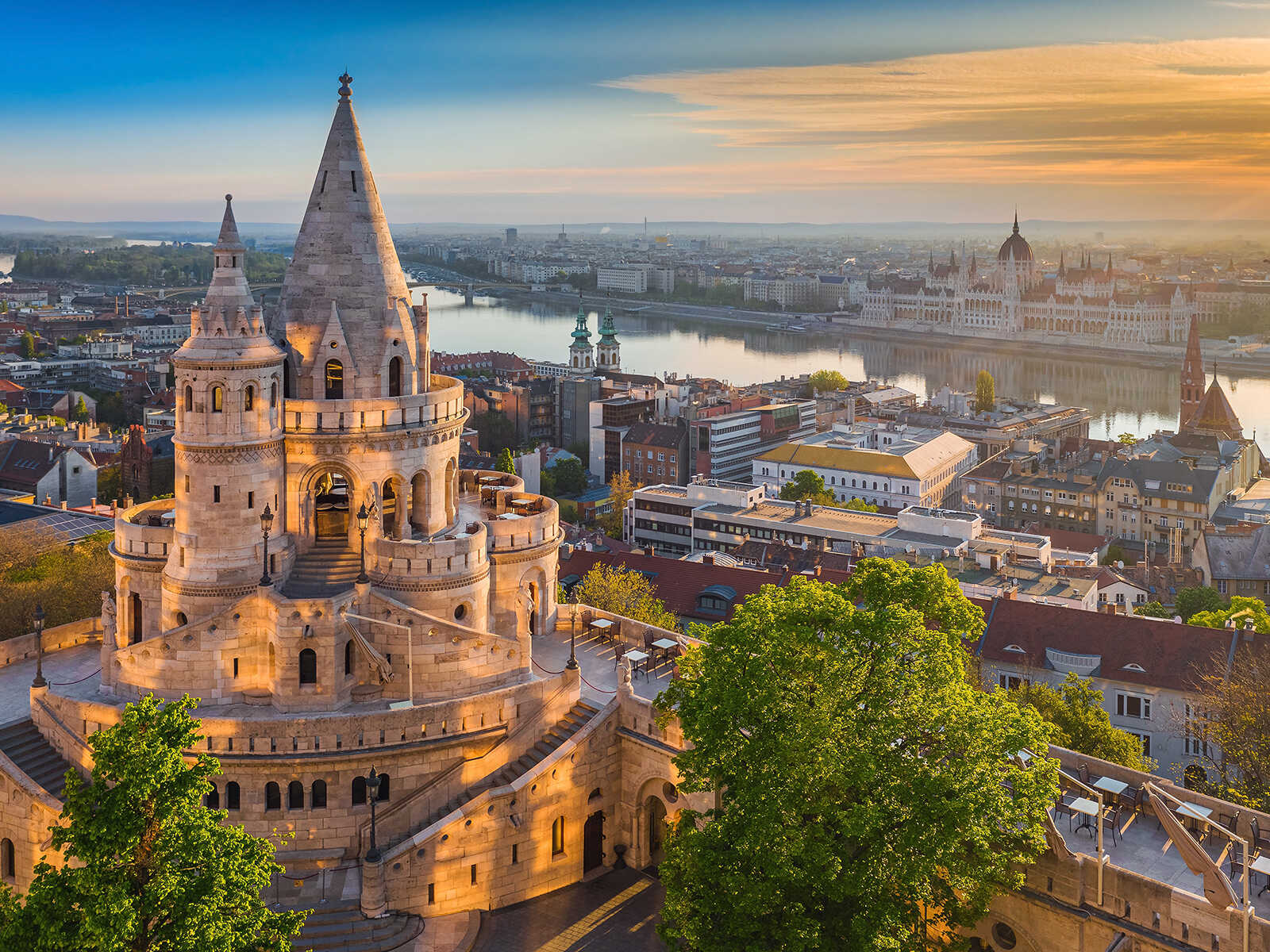
History of Hungary: Habsburg Empire to Modern Budapest
Hungary's history is a captivating saga of empires, revolutions, and enduring national spirit. From its medieval origins through centuries under Habsburg rule to its emergence as a vibrant modern European nation, the country offers a rich tapestry of historical sites and cultural legacies awaiting discovery.
The Foundations: A Kingdom Forged in Fire
Before the Habsburgs, Hungary established itself as a powerful medieval kingdom in Central Europe. The Magyars, a nomadic people, settled the Carpathian Basin in the 9th century, with their chieftain Árpád laying the groundwork for a unified state. By 1000 AD, King Stephen I was crowned, establishing Christianity and a strong monarchy. Sites like the magnificent Esztergom Basilica stand as testaments to this early Christianization and the kingdom's power.
The medieval period saw Hungary flourish, particularly under King Matthias Corvinus in the 15th century, whose Renaissance court at the Royal Palace of Matthias Corvinus was renowned across Europe. However, this golden age was tragically cut short by the Ottoman invasion. The decisive Battle of Mohács in 1526 led to the collapse of the independent Hungarian kingdom, dividing the land into three parts: Ottoman-occupied central Hungary, the independent Principality of Transylvania, and Royal Hungary, which fell under Habsburg rule.
Fun Fact:King Matthias Corvinus, a revered figure in Hungarian history, was known for his vast library, the Bibliotheca Corviniana, one of the largest in Europe during his time.
The Habsburg Embrace: An Empire's Influence
For nearly two centuries, the Habsburgs, rulers of Austria and the Holy Roman Empire, grappled with the Ottomans for control of Hungary. By the end of the 17th century, most of Hungary was liberated from Ottoman rule and integrated into the vast Habsburg Monarchy. This period marked a profound shift, intertwining Hungary's destiny with that of the Austrian Empire for over 300 years.
Under Habsburg rule, Hungarian culture and architecture began to reflect European Baroque and Neoclassical styles. Major reconstruction efforts followed the Ottoman period, particularly in cities like Buda. The sprawling Buda Castle complex, with its various palaces and courtyards, saw significant development under Habsburg patronage, becoming a symbol of both imperial power and Hungarian aspirations.
The Dual Monarchy: Austro-Hungarian Compromise
The 19th century was a time of burgeoning nationalism across Europe, and Hungary was no exception. After a failed revolution in 1848-49 seeking greater autonomy, a political compromise was reached in 1867. The Austro-Hungarian Compromise established the Dual Monarchy, recognizing the Kingdom of Hungary as an equal partner to the Austrian Empire, sharing a common monarch (the Habsburg emperor), foreign policy, and defense, but with separate parliaments and internal governance.
This era, often called the "Golden Age," saw rapid industrialization and modernization, particularly in Budapest. The city transformed into a grand European capital, with iconic landmarks erected during this period:
- The majestic Hungarian Parliament Building, an architectural masterpiece on the banks of the Danube.
- The grand Hősök tere(Heroes' Square), commemorating Hungarian national leaders.
- The fairytale-like Fishermen’s Bastion, offering panoramic views of the Danube and Pest.
- The opulent Széchenyi Thermal Bath, reflecting Budapest's status as a spa city.
Wars, Revolutions, and Republics: The 20th Century
The end of World War I brought the collapse of the Austro-Hungarian Monarchy. The Treaty of Trianon in 1920 was devastating for Hungary, ceding two-thirds of its territory and population to neighboring states. This trauma profoundly shaped Hungarian national identity and foreign policy for decades.
Hungary's interwar period was marked by instability, leading to its alignment with the Axis powers in World War II. The war brought immense destruction, followed by Soviet occupation. In 1949, Hungary became a communist People's Republic under Soviet influence. The brutal realities of this regime are starkly documented at the House of Terror museum in Budapest.
A yearning for freedom erupted in the 1956 Hungarian Revolution, a brave but ultimately crushed uprising against Soviet rule. The Citadella on Gellért Hill served as a strategic point during various conflicts, including the 1956 revolution. The subsequent decades saw a gradual easing of communist policies, but true liberation only came with the collapse of the Soviet Union.
Travel Tip:To understand the transition from communism, visit Memento Park, an open-air museum preserving statues and monuments from the communist era, offering a unique glimpse into Hungary's recent past.
Post-Communism: Modern Hungary and Budapest
The fall of communism in 1989 marked a new chapter for Hungary. The country transitioned to a democratic republic and a market economy, joining NATO in 1999 and the European Union in 2004. Budapest quickly re-established itself as a major European capital, blending its rich historical heritage with modern dynamism.
Today, Hungary is a vibrant nation that proudly preserves its unique culture and history while embracing its place in contemporary Europe. Budapest, in particular, stands as a living museum, where Roman ruins, Ottoman baths, Habsburg grandeur, and communist-era relics coexist, telling a continuous story of resilience and transformation.
Visiting Hungary's Historical Legacy
Exploring Hungary's history is an immersive experience. From the ancient stones of Pécs Cathedral to the defensive walls of the Castle of Eger, and through the magnificent edifices of Budapest, visitors can trace the nation's journey through the ages. Each site offers a piece of the puzzle, revealing the layers of empire, conflict, and cultural fusion that have shaped this remarkable country. Whether you're drawn to imperial grandeur or the poignant reminders of 20th-century struggles, Hungary's past is waiting to be uncovered.