
A Brief History of Hungary: From the Magyar Conquest to Modern Times
Hungary, a landlocked nation in Central Europe, boasts a history as rich and complex as its vibrant culture. From the arrival of nomadic tribes to its modern democratic state, Hungary's past is a tapestry woven with tales of conquest, resilience, and cultural flourishing. Understanding its journey provides invaluable context for appreciating this remarkable country today.
The Magyar Conquest and the Foundation of Hungary (c. 895 – 1000 AD)
The story of Hungary truly begins in the late 9th century with the arrival of the Magyar tribes. Led by Prince Árpád, these formidable nomadic warriors migrated from the Eurasian steppes, settling in the Carpathian Basin around 895 AD. This pivotal event, known as theMagyar Conquestor Honfoglalás, laid the groundwork for the future Hungarian nation.
Initially, the Magyars were known for their raids across Europe. However, under the leadership of Prince Géza and later his son, Stephen I, they began to embrace Christianity and integrate into the European political system. Stephen I, crowned King in 1000 AD, is revered as the founder of the Hungarian state. He established a powerful kingdom, organized the church, and introduced Western European feudalism, firmly embedding Hungary in the Christian West. The magnificent Esztergom Basilica stands today as a testament to the early ecclesiastical foundations laid during this period.
Medieval Hungary: Expansion, Golden Ages, and Decline (1000 – 1526)
Following Stephen I, the Árpád dynasty continued to rule for over three centuries, consolidating the kingdom's power and expanding its influence. This era saw the development of Hungarian law, including the issuance of theGolden Bull of 1222, a charter of liberties that limited the monarch's power, sometimes compared to England's Magna Carta.
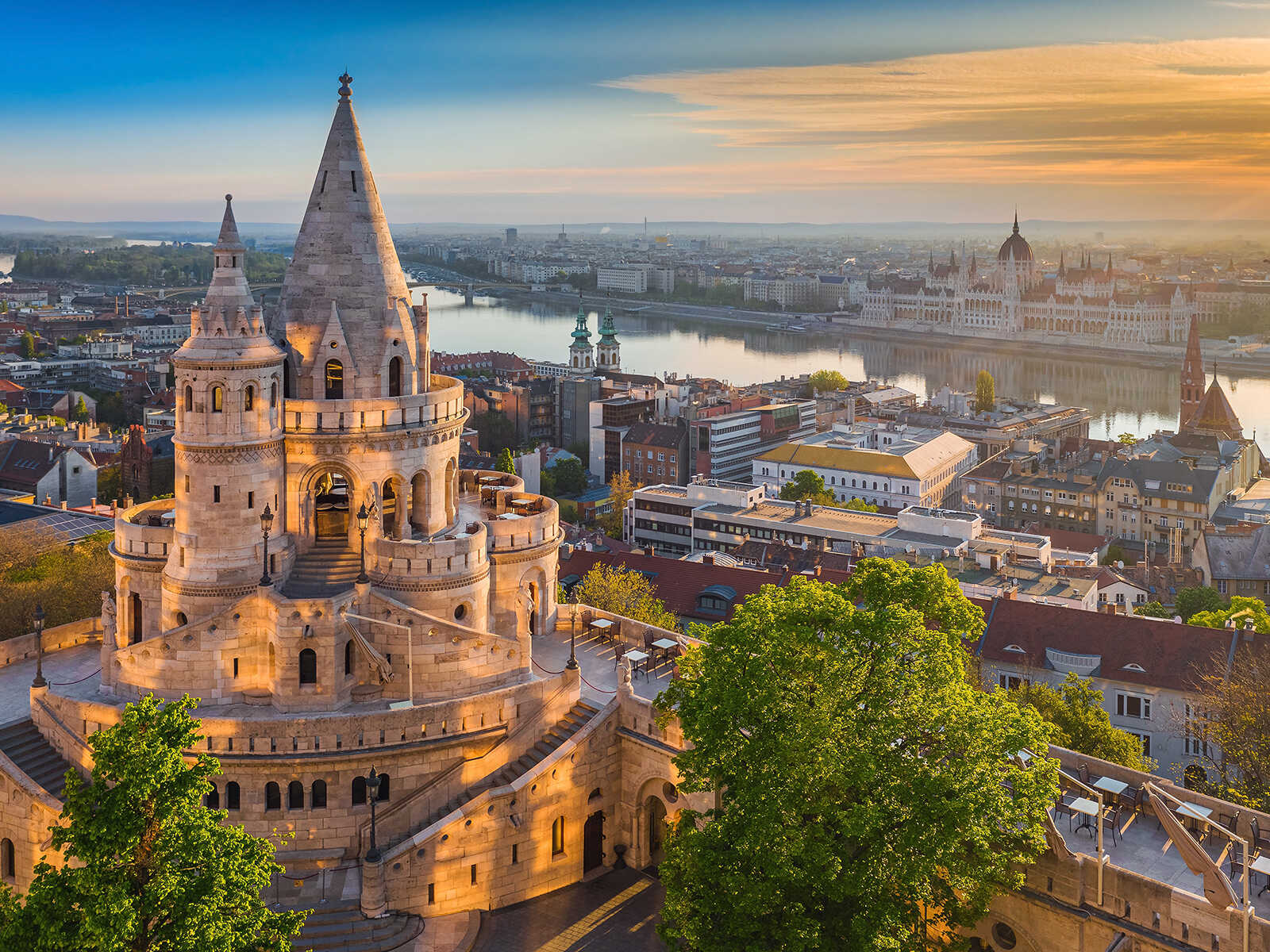
A major challenge to the nascent kingdom came with the devastatingMongol Invasionof 1241-1242. While causing widespread destruction, King Béla IV led the reconstruction effort, emphasizing the building of stone castles and fortifications, including the origins of Buda Castle, to better defend against future threats. The Fishermen’s Bastion, though built much later, evokes the strategic importance of the Buda hill.
"The Mongol invasion, while catastrophic, inadvertently spurred significant development in Hungary, as King Béla IV prioritized rebuilding and fortification, forever changing the landscape."
The late medieval period saw Hungary flourish under various dynasties. King Louis I the Great (Anjou dynasty) expanded the kingdom to its greatest territorial extent, from the Adriatic to the Black Sea. The Renaissance truly arrived in Hungary during the reign of King Matthias Corvinus (1458-1490). A patron of arts and sciences, he transformed Hungary into a major European power and established one of the continent's finest libraries, the Bibliotheca Corviniana. His legacy is still visible in parts of the Royal Palace of Matthias Corvinus.
However, this golden age was tragically cut short. TheBattle of Mohács in 1526resulted in a crushing defeat by the Ottoman Empire, marking the end of independent medieval Hungary and ushering in a long period of foreign domination.
Ottoman Occupation and Habsburg Rule (1526 – 1867)
For the next 150 years, Hungary was divided into three parts: the central and southern regions under direct Ottoman occupation, western and northern Hungary under Habsburg rule, and the semi-independent Principality of Transylvania to the east. This period was marked by continuous warfare and significant cultural shifts, particularly in the Ottoman-held territories. Cities like Eger, with its formidable Castle of Eger, played crucial roles in resisting Ottoman expansion.
By the late 17th century, the Habsburgs, with the help of European allies, successfully expelled the Ottomans from Hungary. However, this liberation came at a cost, as Hungary became fully integrated into the vast Habsburg Monarchy. The subsequent centuries saw a struggle between Hungarian national aspirations and Habsburg centralizing policies. Notable uprisings, like Rákóczi's War of Independence in the early 18th century and theHungarian Revolution of 1848-49, sought greater autonomy. The Citadella on Gellért Hill in Budapest, while built later by the Habsburgs, symbolizes their control and the strategic importance of the capital during these turbulent times.
The Compromise of 1867, known as theAusgleich, finally brought about a dual monarchy:Austria-Hungary. This agreement granted Hungary significant internal autonomy within the Habsburg Empire, leading to a period of unprecedented economic and cultural growth.
The Austro-Hungarian Monarchy and the World Wars (1867 – 1945)
The late 19th and early 20th centuries were a golden age for Hungary, particularly for its capital, Budapest. Rapid industrialization and urbanization transformed the city into a magnificent European metropolis, exemplified by the construction of the iconic Hungarian Parliament Building and the grand Hősök tere(Heroes' Square) for the Millennium celebrations of 1896, commemorating 1000 years since the Magyar conquest.
However, this prosperity was shattered byWorld War I. As part of the Central Powers, Austria-Hungary suffered immense losses. The war's end brought the dissolution of the monarchy and the signing of the devastatingTreaty of Trianon in 1920. This treaty stripped Hungary of two-thirds of its territory and over half of its population, leaving deep scars on the national psyche and contributing to political instability in the interwar period.
In the lead-up toWorld War II, Hungary, seeking to revise the Trianon borders, aligned itself with Nazi Germany. The war brought further tragedy, including the Holocaust and eventually Soviet occupation, marking the beginning of another challenging era.
The Communist Era and the Path to Democracy (1945 – Present)
Following World War II, Hungary fell under Soviet influence, becoming a satellite state and adopting a communist system. The country was renamed the Hungarian People's Republic, and political freedoms were severely curtailed. This period is starkly documented at the House of Terror Museum in Budapest, which chronicles the atrocities committed by both the fascist and communist regimes.
Resentment against Soviet control and the repressive regime boiled over in the1956 Hungarian Revolution. Though initially successful, the uprising was brutally crushed by Soviet tanks, leading to thousands of deaths and widespread emigration. Despite the repression, Hungary under János Kádár eventually adopted a more liberal form of communism, often referred to as "Goulash Communism," which allowed for some economic reforms and a higher standard of living compared to other Eastern Bloc countries.
The late 1980s saw the gradual weakening of Soviet power. In 1989, Hungary played a significant role in the fall of the Iron Curtain, opening its borders to East German refugees and paving the way for peaceful transition to a democratic parliamentary republic. The statues and symbols of the communist era were removed from public spaces and preserved in Memento Park, a unique open-air museum.
Since regaining its sovereignty, Hungary has embraced market economics and integrated into the European community. It joined NATO in 1999 and the European Union in 2004, marking its full return to the European mainstream. Today, Hungary is a vibrant nation that proudly preserves its unique cultural heritage while navigating the complexities of the modern world.
Conclusion
Hungary's history is a compelling narrative of survival, adaptation, and unwavering national identity. From the nomadic Magyars establishing a kingdom in the heart of Europe to enduring centuries of foreign rule and emerging as a modern democracy, the Hungarian spirit has proven remarkably resilient. Exploring its historical sites offers a profound connection to this extraordinary past and a deeper appreciation for the country's enduring legacy.