
A Brief History of Chile: From Ancient Civilizations to Modern Nation
Stretching over 4,300 kilometers along South America's southwestern coast, Chile boasts a history as diverse and dramatic as its geography. From the earliest indigenous settlements to its modern democratic status, this captivating nation has been shaped by unique cultures, colonial powers, and resilient people. Join us on a journey through time to uncover the rich tapestry of Chile's past.
Ancient Roots: Pre-Columbian Civilizations
Long before European explorers sighted its shores, Chile was home to a variety of indigenous cultures, each adapted to the country's extreme climatic zones. In the arid north, groups like theChinchorro(famous for some of the world's oldest mummies) thrived along the coast, while inland, theAtacameñosdeveloped sophisticated agricultural techniques and built impressive pucarás (fortresses) in places like the Atacama Desert. Further south, along the fertile Elqui River valley, theDiaguitapeople were renowned for their intricate pottery and agricultural practices.
The central and southern regions were dominated by theMapuche, a fiercely independent people whose name means "people of the land." They developed a complex society based on agriculture, hunting, and a strong spiritual connection to their territory. Unlike many other South American civilizations, the Mapuche largely resisted the expansion of the Inca Empire, which only managed to extend its influence as far south as the Maipo River, barely touching the Mapuche heartland.
Did You Know?The Chinchorro mummies, dating back over 7,000 years, predate Egyptian mummies by several millennia, showcasing an incredibly advanced understanding of preservation techniques by these ancient Chilean inhabitants.
The Arrival of Europeans and Colonial Rule
The first European to set foot in what is now Chile was Ferdinand Magellan in 1520, navigating the strait that bears his name at the southern tip of the continent. However, it was Diego de Almagro, a companion of Francisco Pizarro, who led the first Spanish expedition into Chile in 1535. His search for gold proved futile, and his journey was fraught with hardship through the Atacama Desert and the Andes.
The true conquest began in 1540 with Pedro de Valdivia, who, despite Almagro's warnings, ventured south from Peru. On February 12, 1541, he founded Santiago del Nuevo Extremo, establishing the first permanent Spanish settlement at the foot of Santa Lucía Hill. Valdivia faced immediate and fierce resistance from the Mapuche, initiating the long and brutal Arauco War. This conflict would rage for centuries, defining the southern frontier of the Spanish Empire and cementing the Mapuche's reputation as formidable warriors.
Chile became part of the Viceroyalty of Peru, a relatively isolated and often overlooked captaincy-general due to its remote location and constant indigenous conflicts. The economy was primarily agricultural, with some mining, but it lacked the vast mineral wealth of Peru or Mexico. Valparaíso emerged as an important port city for trade and communication with the wider Spanish Empire.
The Path to Independence
The early 19th century brought winds of change across Latin America. Inspired by Enlightenment ideals and the Napoleonic Wars in Europe, which weakened Spain's grip on its colonies, movements for independence began to flourish. In Chile, the process began on September 18, 1810, with the establishment of the First National Junta, marking the start of thePatria Vieja(Old Fatherland) period.
The struggle for independence was not swift or easy. Royalist forces often regained control, leading to periods of intense fighting. Key figures like Bernardo O'Higgins, often considered Chile's "Father of the Nation," and the Argentine general José de San Martín played pivotal roles. Their combined forces crossed the Andes in a daring maneuver, ultimately securing Chilean independence with a decisive victory at the Battle of Maipú on April 5, 1818. O'Higgins then served as Supreme Director, laying many of the foundations for the new republic.
Building a Republic: 19th Century Expansion and Conflict
Following independence, Chile embarked on a period of nation-building and consolidation. The country established a stable republican government relatively early compared to its neighbors. The 19th century saw significant territorial expansion, most notably through the War of the Pacific (1879-1884), also known as the Nitrate War. Chile emerged victorious against Peru and Bolivia, gaining vast territories in the north, including the rich nitrate deposits of the Atacama Desert. This transformed Chile into a leading global exporter of nitrates, fueling economic growth and solidifying its position as a regional power.
Concurrently, the "Pacification of Araucanía" campaign gradually brought the Mapuche territories in the south under Chilean control, opening up new lands for agriculture and settlement. The port city of Valparaíso flourished as a vital hub for Pacific trade, characterized by its distinctive colorful hills and unique architecture.
20th Century: Social Change and Political Turmoil
The early 20th century brought social and political challenges. The parliamentary republic system, while outwardly stable, masked deep inequalities and labor unrest, particularly among nitrate miners and urban workers. This period saw the rise of populist movements and an increasing demand for social reforms.
Mid-century, Chile experienced a series of democratic governments, with growing political polarization. This culminated in 1970 with the election of Salvador Allende, a democratic socialist, who became the first Marxist president to be freely elected in a non-communist country. His government pursued ambitious reforms, including nationalization of industries and land redistribution, which faced strong opposition both domestically and internationally. The political and economic climate deteriorated rapidly, leading to widespread unrest.
The Pinochet Era and Return to Democracy
On September 11, 1973, General Augusto Pinochet led a military coup d'état, overthrowing Allende's government, which tragically ended with the president's death. This marked the beginning of a 17-year military dictatorship. Pinochet's regime implemented drastic free-market economic reforms, which laid the groundwork for modern Chile's economic success but also came at a severe cost to human rights, with thousands imprisoned, tortured, or killed.
By the late 1980s, international pressure and internal dissent grew. In 1988, Pinochet called for a plebiscite on his continued rule, confident of victory. However, the Chilean people voted overwhelmingly against him, paving the way for a peaceful transition to democracy. Patricio Aylwin was elected president in 1990, ushering in an era of democratic governments that have worked to consolidate institutions and address the legacy of the dictatorship.
Modern Chile: A Nation of Contrasts
Today, Chile stands as one of South America's most stable and prosperous nations, boasting a vibrant democracy and a diverse, export-oriented economy, with copper remaining a key export. It has embraced its rich cultural heritage while navigating the complexities of modern development, grappling with issues of social inequality and environmental sustainability.
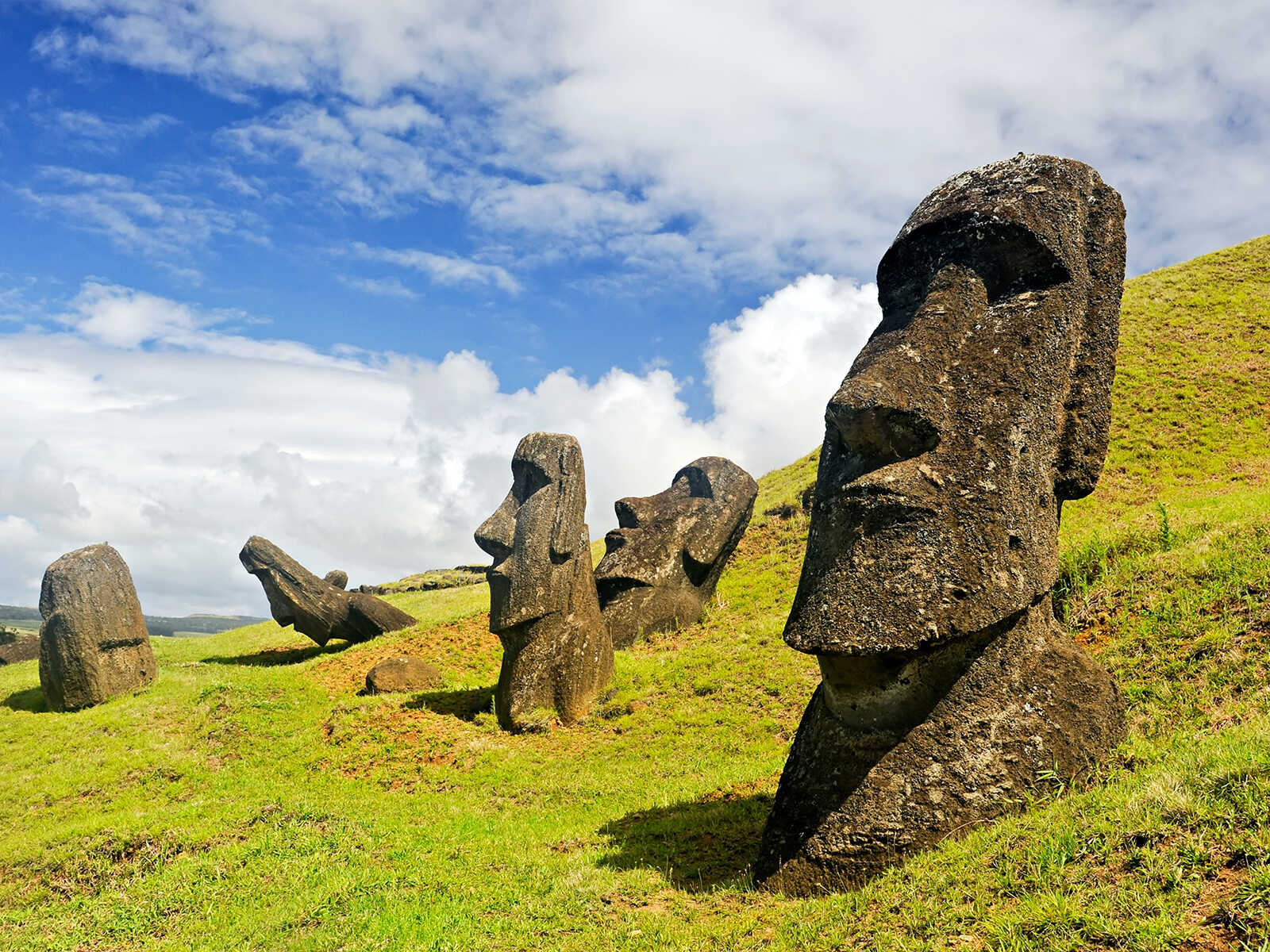
For visitors, Chile offers an unparalleled range of experiences, from the otherworldly landscapes of the Valle de la Luna in the Atacama Desert, to the majestic peaks of Torres del Paine National Park in Patagonia. The central region offers the bustling capital of Santiago, with panoramic views from Cerro San Cristóbal, and the colorful port city of Valparaíso. Further south, explore the mystical Chiloé Island, the pristine waters around the Marble Caves, or the wild beauty of Tierra del Fuego and the Carr Austral. Don't forget the enigmatic Moai of Rapa Nui (Easter Island), with iconic sites like Ahu Tongariki,Rano Raraku, and the sandy beach of Anakena, a testament to an ancient, isolated civilization.
Chile's history is a testament to its enduring spirit, a journey from ancient civilizations to a modern nation that continues to captivate and inspire. Exploring its past offers a deeper appreciation for the landscapes and people that make this long, narrow country so extraordinary.