
The Rich History of Bosnia and Herzegovina: From Empires to Independence
Bosnia and Herzegovina (BiH) is a land where East meets West, a crossroads of civilizations that has shaped its unique identity. Its tumultuous yet captivating history spans millennia, marked by the rise and fall of empires, the blending of cultures, and an enduring spirit of resilience.
Ancient Roots and Roman Rule
The story of Bosnia and Herzegovina begins long before recorded history, with evidence of Neolithic settlements dating back thousands of years. The region was home to various Illyrian tribes, known for their distinct culture and resistance to external powers. By the 1st century BCE, the Romans began their conquest, eventually incorporating the territory into the provinces of Dalmatia and Pannonia. Roman rule brought roads, towns, and Latin influence, leaving behind archaeological sites and a lasting administrative framework.
Following the decline of the Roman Empire, various Germanic tribes and later Slavic peoples migrated into the Balkans. By the 7th century, Slavic tribes had firmly established themselves, laying the foundations for the distinct South Slavic identity that would characterize the region.
Medieval Bosnia: A Kingdom Emerges
The medieval period saw the gradual formation of an independent Bosnian state. Initially a banate, a semi-autonomous region under Hungarian suzerainty, Bosnia steadily grew in power and influence. Ban Kulin (1180-1204) is often considered one of Bosnia's most significant early rulers, whose reign brought a period of peace and economic prosperity. The Bosnian Church, a unique indigenous Christian denomination often (and controversially) associated with Bogomilism, also flourished during this era, distinguishing Bosnia from its Catholic and Orthodox neighbors.
Did You Know?The medieval Bosnian Kingdom reached its zenith under King Tvrtko I Kotromanić (1353-1391), who expanded its territories significantly and was crowned King of Serbia, Bosnia, and the Coast. His reign is often remembered as a golden age for Bosnian statehood.
The Bosnian Kingdom maintained its independence for several centuries, often navigating complex political landscapes between powerful neighbors like Hungary and Serbia. Its rich cultural output included distinctive tombstones known asstećci, monumental stone slabs adorned with intricate carvings, which are now a UNESCO World Heritage site.
The Ottoman Empire's Legacy
The late 14th and 15th centuries brought a new, formidable power to the Balkans: the Ottoman Empire. Following the Battle of Kosovo in 1389, Ottoman influence grew, leading to the conquest of Bosnia in 1463 and Herzegovina shortly thereafter. This marked a profound turning point, shaping the region's demographics, culture, and architecture for nearly four centuries.
Under Ottoman rule, many Bosnians converted to Islam, contributing to the unique multi-ethnic and multi-religious fabric of the country. Cities like Sarajevo and Mostar flourished as important administrative and trade centers. Ottoman engineering and aesthetics left an indelible mark, evident in the construction of mosques, bridges, and bazaars. Visitors can still experience this rich heritage in places like Baščaršija, Sarajevo's historic Ottoman marketplace, or marvel at the architectural prowess of the Old Bridge in Mostar, a symbol of Ottoman design and cross-cultural connection. Another stunning example is the Mehmed Paša Sokolović Bridge in Višegrad, a UNESCO site immortalized in literature. The tranquil Blagaj tekija, a Dervish monastery nestled at the base of a cliff near the source of the Buna River, also stands as a testament to Ottoman spiritual and architectural influence.
Austro-Hungarian Era: Modernization and Tensions
In 1878, following the Congress of Berlin, Bosnia and Herzegovina came under the administration of the Austro-Hungarian Empire, formally annexed in 1908. While Ottoman rule ended, the blend of cultures persisted, now with a new layer of Central European influence. The Austro-Hungarians initiated significant modernization projects, including the construction of railways, schools, and urban infrastructure, particularly in Sarajevo.
However, this period was also marked by rising nationalism among the South Slavs, who yearned for a unified independent state. These simmering tensions famously erupted in Sarajevo on June 28, 1914, with the assassination of Archduke Franz Ferdinand, the Austro-Hungarian heir, an event that triggered the outbreak of World War I.
Yugoslavia: Unification and Division
After World War I, Bosnia and Herzegovina became part of the newly formed Kingdom of Serbs, Croats, and Slovenes, later renamed the Kingdom of Yugoslavia. The interwar period was characterized by political instability and economic challenges. World War II brought immense suffering to the region, with brutal occupation and widespread ethnic conflict.
Following WWII, Bosnia and Herzegovina became one of the six constituent republics of the Socialist Federal Republic of Yugoslavia, led by Josip Broz Tito. This era (1945-1992) saw a concerted effort to foster "Brotherhood and Unity" among its diverse populations. BiH experienced significant industrialization and development, and its unique cultural diversity was largely celebrated within the Yugoslav framework. The country's anti-fascist resistance during WWII is commemorated at sites like Sutjeska National Park, a place of immense natural beauty and historical significance.
The Path to Independence and the Bosnian War
The late 1980s and early 1990s witnessed the gradual disintegration of Yugoslavia. As other republics declared independence, Bosnia and Herzegovina held a referendum in March 1992, with a majority voting for sovereignty. This declaration, however, was not universally accepted and quickly spiraled into the devastating Bosnian War (1992-1995).
The war was a brutal conflict marked by ethnic cleansing, siege warfare, and immense human suffering. Sarajevo endured the longest siege of a capital city in modern history. The resilience of its people during this dark period is powerfully illustrated by sites like the Sarajevo Tunnel, a lifeline built under the airport runway to bring supplies into the besieged city.
The war concluded with the Dayton Peace Agreement in December 1995, which established the current political structure of Bosnia and Herzegovina as a single state composed of two entities: the Federation of Bosnia and Herzegovina and the Republika Srpska, with Brčko District as a separate self-governing administrative unit.
Bosnia and Herzegovina Today: A Resilient Nation
Today, Bosnia and Herzegovina is a country in ongoing recovery and development, actively working towards a future of peace and prosperity. Its complex history has forged a unique identity, where Ottoman minarets stand alongside Austro-Hungarian facades and medieval fortresses overlook modern cities. The blend of cultures, religions, and traditions makes it a fascinating destination for travelers.
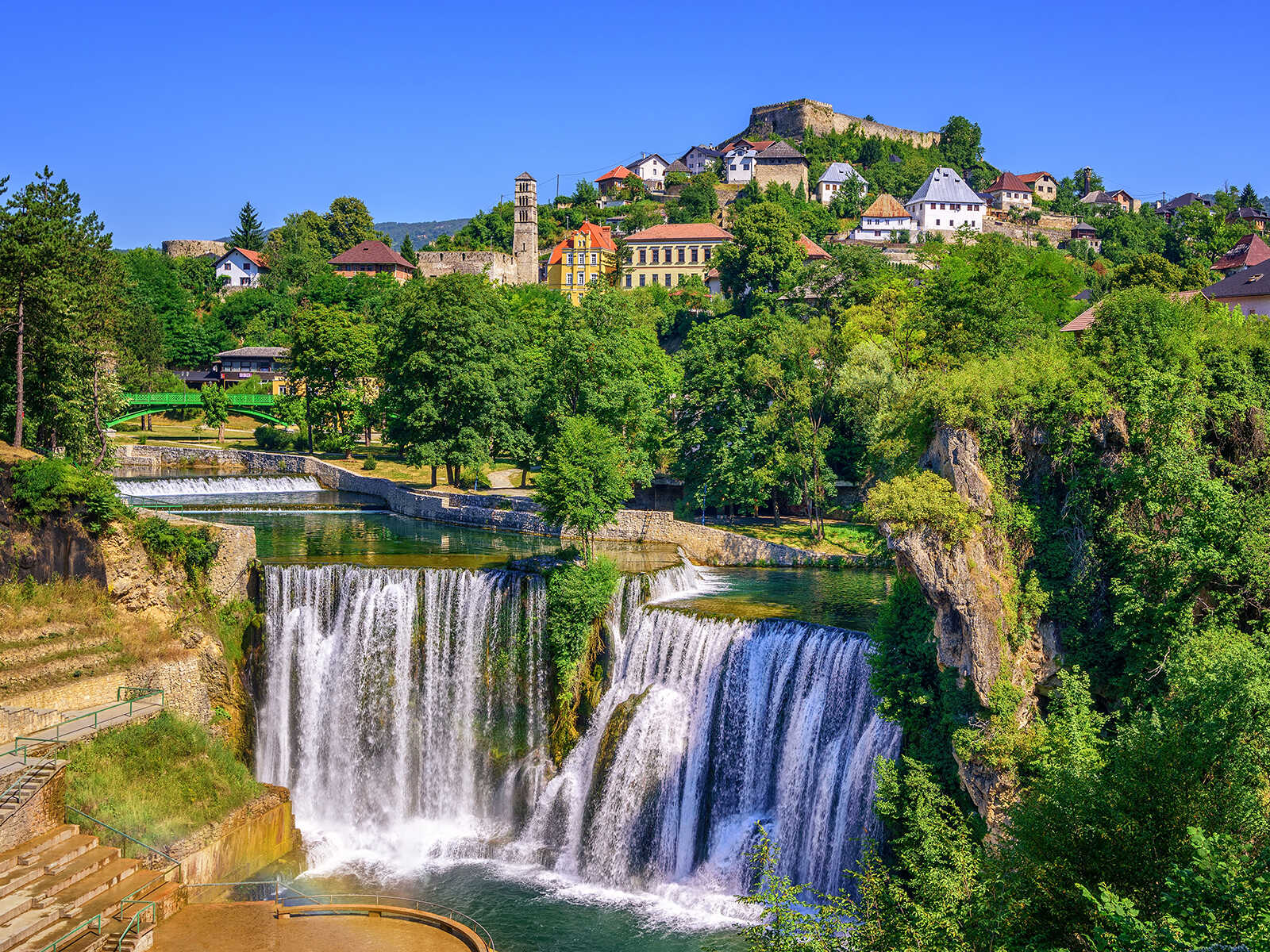
Beyond its cities, BiH boasts breathtaking natural beauty, from the Olympic slopes of Jahorina to the pristine waters of Kravice Waterfalls. The stunning landscapes of Una National Park and Sutjeska National Park offer opportunities for outdoor adventure, while the serene springs of Vrelo Bosne and the majestic Pliva Waterfall showcase its natural wonders. Exploring this country is to walk through layers of history, experiencing the echoes of empires and the vibrant spirit of an independent nation.
From its ancient Illyrian roots to the medieval Bosnian Kingdom, through the centuries of Ottoman and Austro-Hungarian rule, and its time within Yugoslavia, Bosnia and Herzegovina has emerged as a resilient nation with a profound story to tell. Its rich history is not just a collection of dates and events, but a living tapestry woven into its landscapes, its architecture, and the hearts of its people. Visiting BiH offers a unique opportunity to witness this incredible journey firsthand.